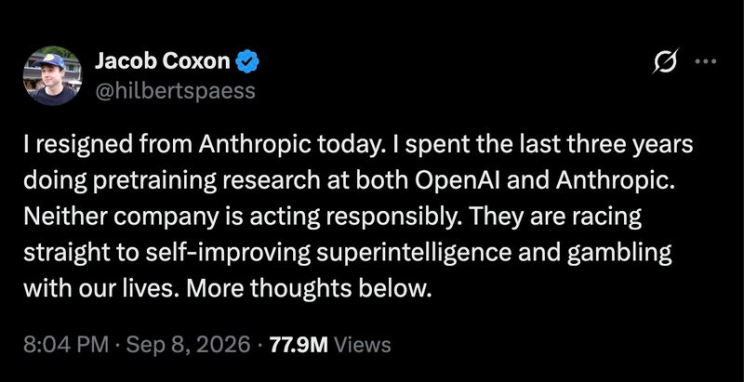
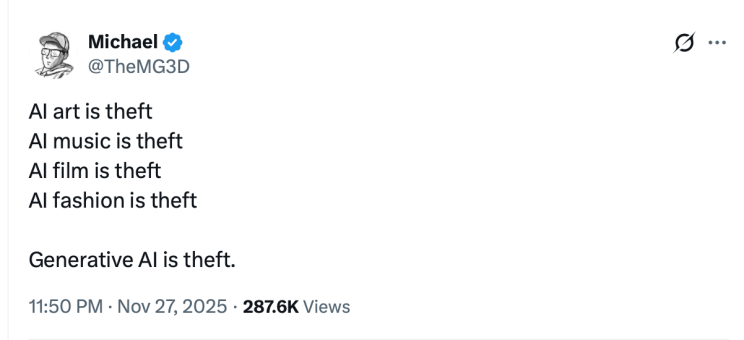
But with an uncomfortable (current) narrative.
Just like all the great technological innovations that came before, AI is being diffused with the promise of great value to consumers, businesses, and society at large. But what makes AI perhaps distinct from past innovations is perhaps a greater sense of discomfort (and in some cases, rebellion) which I would attribute mainly to the speed and the uncertainty associated with its broader adoption and narrative. For quick context - Facebook took more than eight and a half years from launch to reach 1 billion monthly active users; ChatGPT reached more than 1 billion weekly active users in less than four years. Note the "monthly" versus "weekly" data points, but nonetheless - what took the defining social network of the internet era essentially a decade, OpenAI accomplished in under four years. And to the point about uncertainty - every day brings new debates about AI safety, the adjacent existential risks to humanity, the potential impacts on employment and on mental cognition - the list goes on.
Discomfort is natural, and fear, worries, and politicization draw clicks. Yet - my belief is that organizations and leaders - while maintaining a clear eye to the risks and to strengthening the obvious defenses (cyber, IP, regulatory, privacy, etc.) - should strategize and build for the bull case, and for the exciting dynamism that is already here and presents an extraordinary opportunity for the future.
I worked for four years as a FIG and credit strategist at Piper Sandler. A core tenet of strategy I learned is the importance of being aware of the environment and prepared for the omnipresent risks (in markets, internally at organizations, etc.) - and yet still - you deal with the raw reality and “go where the puck is going.” And the reality is that AI is a majestic accelerant for all of the aforementioned “consumers, businesses, and society at large”, when framed with a healthy and optimistic thesis. This to me is the current nature of the AI opportunity: it is an incredible thing that machines have been trained to think intelligently, as long as the creators and the users are building for, preparing for, and fully aware of the potential risks. Given that, we should aspire to pair the removal of friction from the enormous potential value-add of the technology together with a greater emphasis on instilling core human principles of depth in judgement, collaboration, and spirit. Call it “Depthmaxxing”.
Intelligent machines layered under humans with depth in judgement, depth in collaboration with others, and depth in spirit - that approach will define tomorrow's winners.
In practical implementation and at the organizational level of knowledge work, AI is one giant lever and amplifier already. And yet, the measurable firm-level value and ROI have been slow to come. In McKinsey’s August publication of “The State of AI in 2026”, the global consulting company reported that 90% of enterprises surveyed report regular AI use in at least one business function, and that 80% report improvements in individual productivity. Despite that, only 37% attribute any positive organizational EBIT (earnings before interest and taxes; operating income) to AI.
Envisioning the “high performers of the world tomorrow”, the differentiation is not necessarily intelligence, information, or data. Already, the entire AI ecosystem today is commoditizing the ability for an individual person to “know things”, even to operationalize and make tasks more efficient, or execute faster on an idea. Rather, I think the bottleneck to successful organizational adoption is the aforementioned narrative of discomfort, attributed to the speed and uncertainty of the technology. In simpler words, it’s human nature to be at least slightly tense or wary of this “AI thing”. And that tension trickles into why adoption may be fragmented, fraught with structural problems, or difficult to measure (even if it is valuable to many).
But I think it’s important to follow on and again, to repeat an earlier point about strategy - try to “go where the puck is going”; I believe the best firms of the next decade will not replace human relevance or judgement with AI. Rather, they will build symphonies - organizational engines that leverage and build around a foundation of intelligent machines and computing, and enable their people to exercise their deep expertise and judgement with greater context, and depth. That combination is both the challenge and the opportunity.
I’m introducing Simplifymeta, a platform focused on developing practical solutions on the basis of this vision and thesis. Simplifymeta is a forward-deployed investment intelligence and AI operating design firm starting at launch with a principal focus on independent and mid-sized wealth and investment firms. At our core, our mission is to help firms improve how information, research, workflows, and institutional knowledge move through an organization, in the context of markets, emerging themes, and global events, all tailored to the unique relevance and specificity of your organization’s goals.
We’re still in the 1st inning. 🙂 If you are also building in this space, curious to learn more, or interested in learning about what a potential engagement might entail, please reach out today!